Category: People

Summer research summary

Si3mdrnce returning from a week of walking August has included making final preparations for #MHNR2019, which is looking very exciting. Elsewhere, a big part of my work this month has been writing an analysis of qualitative interview data generated as part of a phase 2 trial of 3MDR for military veterans with treatment-resistant post-traumatic stress disorder. 3MDR, or Modular motion-assisted memory desensitisation and reconsolidation, is a novel psychological intervention involving walking on a treadmill towards personally selected images of trauma whilst in the company of a skilled therapist. The study is led by Jon Bisson, and here are Neil Kitchiner and John Skipper talking about what it involves:

Working on a trial has been an interesting, and new, experience for me, and I’ve been learning lots. My qualitative write-up is destined for inclusion in a final report for the trial’s funding body, Forces in Mind Trust, but during this work as a team we’ve also been planning papers for publication.

menloc logo 5MENLOC, our ongoing evidence synthesis into end of life care for people with severe mental illnesses (about which I have written on this blog before), is in full swing. We’ve reached the stage where we’re writing up syntheses of the research papers and other outputs we’ve included, organised via a series of themes. More on this to follow in due course.

Finally, it’s been good to work in support of colleagues who have led new papers for publications. Here’s Jane Davies‘ latest paper on the experiences of partners of young people living with cancer, and a paper led by Ray Samuriwo on wound care and mental health.

Nursing numbers

Next week I’ll be in London for this year’s Eileen Skellern and JPMHN Award evening, hearing Mick McKeown give his Making the most of militant and maverick tendencies for mental health nursing Skellern lecture and Patrick Callaghan deliver his Lifetime Achievement Award address. The day following, June 14th, I’ll be at Kingston/St George’s chairing the summer meeting of Mental Health Nurse Academics UK. One of the things we’ll we talking about is NHS England’s Interim People Plan, which looks to be prioritising mental health nursing as an occupational group in need of support. Here’s a short piece I wrote yesterday for the MHNAUK website, complete with a toxic-looking figure showing the decline in applications for nursing degrees:

The NHS needs more mental health nurses. The most recently available data on the size and composition of the workforce in NHS England, for February 2019, records a total of 36,290 mental health nurses. This compares to an NHS England mental health nursing workforce in September 2009 of 40,602.

Published on June 3rd 2019, the Interim NHS People Plan is about supporting the people needed to deliver NHS England’s Long Term Plan. Chapter 3 addresses nursing, this being the profession where the greatest shortages are found and where the most urgent and immediate action must be taken. Mental Health Nurse Academics UK welcomes the identification of mental health nursing as a priority group, and notes the Interim People Plan’s statement that what must now happen is:

[…] a detailed review across all branches of pre-registration nursing, including a strong focus on the steps needed in mental health and learning disability nursing to support growth in these areas.

The Plan echos Mental Health Nurse Academics UK’s view that undergraduate degree courses offer the best way to secure a future supply of nurses. It also reproduces a figure pointing to a sharp decline in applications for nursing and midwifery courses in England since the removal of bursary support (specifically, a 31% decrease between 2016 and 2018):

Annotation 2019-06-06 120912
Extracted from Interim People Plan, p24

The Interim People Plan places an emphasis on what it refers to as ‘the offer’ made by the NHS to its staff. Mental health nursing needs a better offer if it is to improve the recruitment, retention and support of its current and future members. Mental Health Nurse Academics UK will be looking for concerted action in these areas.

My view is that this decline in applications was entirely foreseeable in the context of the removal of bursaries in England. As it happens, students of nursing and other health professions commencing their programmes of study in Welsh universities in Autumn 2019 can expect to be supported through the award of a bursary, in return for working for two years post-qualification in NHS Wales. That’s a good deal, in my book, and is something presented as part of the country’s wider #TrainWorkLive initiative. I’m not entirely sure how far this ‘Welsh offer’ (to borrow the language of the People Plan) is known throughout other parts of the UK: so I’m happy to give it a nudge here.

COCAPP-A main findings paper

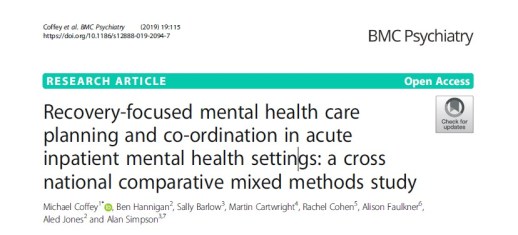
COCAPP-ACOCAPP-A, funded by the NIHR Health Services and Delivery Research Programme, investigated care planning and coordination in inpatient mental health services. It was led by Alan Simpson, and I was mighty pleased to have been part of the research team. The full, 270 page, report appeared in 2017. Now, a derived paper reporting main findings has appeared in the journal BMC Psychiatry. Lead authored by Michael Coffey this article amounts to a more modest 18 pages, which means it stands a chance of actually being read by people able to make use of it.

As a gold open access article the paper is free to download to anyone with an internet connection. As a taster, here’s the abstract:

Background: Involving mental health service users in planning and reviewing their care can help personalised care focused on recovery, with the aim of developing goals specific to the individual and designed to maximise achievements and social integration. We aimed to ascertain the views of service users, carers and staff in acute inpatient wards on factors that facilitated or acted as barriers to collaborative, recovery-focused care.
Methods: A cross-national comparative mixed-methods study involving 19 mental health wards in six service provider sites in England and Wales. This included a survey using established standardised measures of service users (n = 301) and staff (n = 290) and embedded case studies involving interviews with staff, service users and carers (n = 76). Quantitative and qualitative data were analysed within and across sites using descriptive and inferential statistics, and framework method.
Results: For service users, when recovery-oriented focus was high, the quality of care was rated highly, as was the quality of therapeutic relationships. For staff, there was a moderate correlation between recovery orientation and quality of therapeutic relationships, with considerable variability. Staff members rated the quality of therapeutic relationships higher than service users did. Staff accounts of routine collaboration contrasted with a more mixed picture in service user accounts. Definitions and understandings of recovery varied, as did views of hospital care in promoting recovery. Managing risk was a central issue for staff, and service users were aware of measures taken to keep them safe, although their involvement in discussions was less apparent.
Conclusions: There is positive practice within acute inpatient wards, with evidence of commitment to safe, respectful, compassionate care. Recovery ideas were evident but there remained ambivalence on their relevance to inpatient care. Service users were aware of efforts taken to keep them safe, but despite measures described by staff, they did not feel routinely involved in care planning or risk management decisions. Research on increasing therapeutic contact time, shared decision making in risk assessment and using recovery focused tools could further promote personalised and recovery-focused care planning.

#MHNR2019

#MHNR2019With just under one month to go before the deadline for submission of abstracts for the 2019 running of the International Mental Health Nursing Research Conference I thought it an idea to draw attention to this top tips post from two years ago. As I suggested then, conference guidelines are there to be followed. For the past couple of years we’ve published criteria for abstract selection, including information on the structured presentation of quantitative, qualititative and non-empirical abstracts.

And, whilst I’m writing about #MHNR2019, now is a good time to link to this MHNAUK post announcing Sue McAndrew as Mental Health Nurse Academics UK Lecturer for 2019. Sue works at the University of Salford, and will be drawing on her work in children’s and young people’s mental health.

Plan4Recovery

Here’s a post introducing the main findings paper from the Plan4Recovery study, led by Michael Coffey and funded through a Health and Social Care Wales Social Care Research Award.

Plan4Recovery used qualitative and quantitative methods to investigate the relationships between recovery, quality of life, social support and shared decision-making amongst people using social care services in Wales. The project team included mental health researchers with practitioner backgrounds, experience of using services, and of mixed methods studies. The paper, published in the journal Social Psychiatry and Psychiatric Epidemiology, is in gold open access form which makes it free to download.

For a shortcut, here’s the abstract:

Purpose

Mental health care is a complex system that includes social care organisations providing support for people with continuing needs. The relationship over time between decisional conflict, social support, quality of life and recovery outcomes across two time periods for people experiencing mental health problems in receipt of social care was investigated.

Methods

This is a mixed methods study comprised of a quantitative survey at two time points using measures of decisional conflict, social support, recovery and quality of life in a random sample (n = 122) using social care services in Wales, UK. In addition, 16 qualitative case studies were developed from data collected from individuals, a supportive other and a care worker (n = 41) to investigate trajectories of care. Survey responses were statistically analysed using SPSS and case study data were thematically analysed.

Results

Participants reported increasing decisional conflict and decreasing social support, recovery and quality of life over the two time points. Linear regression indicated that higher recovery scores predict better quality of life ratings and as ratings for social support decline this is associated with lower quality of life. Correlational analysis indicated that lower decisional conflict is associated with higher quality of life. Thematic analysis indicated that ‘connectedness and recovery’ is a product of ‘navigating the system of care’ and the experience of ‘choice and involvement’ achieved by individuals seeking help.

Conclusions

These results indicate that quality of life for people experiencing mental health difficulties is positively associated with social support and recovery and negatively associated with decisional delay.

#ACMHN2018

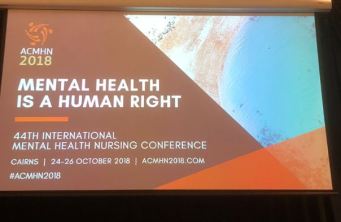
Big thanks to the Board of Directors of the Australian College of Mental Health Nurses (ACMHN) for inviting me to speak at the 44th International Mental Health Nursing Conference, or #ACMHN2018, which took place in Cairns between 24th-26th October 2018. Never having been to Australia before, and indeed having never before left Europe, this was a big deal and I was grateful for the opportunity.

The theme for the conference was ‘mental health as a human right’, and the three days opened with a memorable welcome to country given by Yidinji tribal elder Henrietta Marrie followed by music and dance. Keynote speakers reflected well the conference theme in their talks, variously focusing on tackling health inequalities (including amongst Aboriginal people), suicide prevention in LGBQTI communities, rural mental health, human rights progress in Ireland (and more). Concurrent presentations were also very high-quality. Worth noting, too, is how the ACMHN used its conference to raise awareness of its campaign, being run in concert with other health care organisations, to demand that children and families seeking asylum and currently being held on the island of Nauru be brought to Australia.

In my keynote I elected to speak about mental health policy, services and nursing in Wales and made the point that the Welsh approach to health care is different from that found elsewhere in the UK, or in other parts of the world. To illustrate this I spoke about the Mental Health (Wales) Measure, the introduction of both future generations and safe staffing legislation and the imminent appearance of a Framework for Mental Health Nursing prepared through the All Wales Senior Nurse Advisory Group for Mental Health.

I realise that in the UK we have nothing quite like the ACMHN: a professional organisation comprised of subscribing members, which represents its field, acts as a credentialing body (nursing education in Australia being a generalist one) and which lobbies for better services and higher standards. The College has a Board and an elected president, the current incumbent being Eimear Muir-Cochrane, and employs a team including Kim Ryan as salaried chief executive officer. The ACMHN performs no trade union function (like the RCN, Unite the Union, and Unison in the UK), and does not register or regulate nurses (as the NMC does). Australia looks to have a number of colleges and associations organised along the same lines as the ACMHN, and I’ve found this site which lists bodies advancing practice and representing members in the fields of critical care, midwifery, children and young people’s nursing, and more.

#ACMHN2018 was an excellent experience, and I was pleased to meet roomfuls of fine and interesting people. For the record, #ACMHN2019 takes place in Sydney between 8th-10th October 2019, with the theme of ‘integrated care’.

#MHNR2018 and #ACMHN2018

mosiEarlier this month I made the journey to the Science and Industry Museum in Manchester for the 24th International Mental Health Nursing Research Conference (#MHNR2018). Here’s a snip from the short piece which appeared on the Mental Health Nurse Academics UK (MHNAUK) website:

This is MHNAUK’s conference, run annually in conjunction with the RCN and with support from André Tomlin (The Mental Elf) who used social media to bring the event beyond the room.

Keynote speakers were: Dr Eleanor Longden, who talked about voice-hearing as a complex and significant experience; Professor Sonia Johnson, who spoke about the need to improve lives through improved psychosocial interventions; Professor Alan Simpson, who delivered the second annual MHNAUK lecture with a call for mental health nurses to speak up and assert their value; Professor Sir Robin Murray who spoke about biopsychosocial approaches to understanding, and treating, psychosis; and Dr Jonathan Gadsby who talked about the Critical Mental Health Nurses’ Network and invited delegates to join a discussion on conscientious objection. Concurrent sessions and symposia were packed and lively, and discussions and debates at the venue were mirrored by conference-related discussions taking place online. Podcasts with Robin Murray, Sonia Johnson, Alan Simpson and Laoise Renwick (who chaired the #MHNR2018 conference committee) can be found here on Soundcloud.

Also announced at the conference was news of Professor Mick McKeown as Skellern Lecturer for 2019, and Professor Patrick Callaghan as recipient of the Journal of Psychiatric and Mental Health Nursing Lifetime Achievement Award. Congratulations to both from all in MHNAUK, and we look forward to hearing their addresses at Kingston St George’s, London, on 13th June 2019.

#MHNR2018 closed with a date for the diary: the 25th International Mental Health Nursing Research Conference will take place on 12th-13th September 2019 at the RCN headquarters in London. More details about #MHNR2019 will be posted in due course.

This was an excellent two days, and I reflect on how far the conference showcased variety in perspectives and positions. Now, with John Baker having served a four year term as a member of the conference organising committee, expressions of interest are being sought (through MHNAUK) for an experienced mental health nurse academic to take his place. Planning for #MHNR2019 will begin in earnest towards the end of this year or early next, though as the post reproduced above states we already have our dates and venue confirmed.

Whilst we’re on the subject of conferences: earlier this year I received an invitation from Kim Ryan and the Board of Directors of the Australian College of Mental Health Nurses to speak at the 44th International Mental Health Nursing Conference. This takes place next month, in Cairns, and I’m currently in the process of writing (and rewriting) what I’m going to say. The subtitle to my talk is, ‘observations from a small country’, and I’m going to talk about the distinctiveness of mental health services and nursing in Wales and what can be learned from this. Perhaps when I’m done, and the conference has closed, I’ll post a full set of my slides here to this site.

Skellern Lecture, JPMHN Lifetime Achievement Award and MHNAUK meeting

2018-06-14 18.33.42
Geoff Brennan begins his lecture

Earlier this month I made the trip to the University of Greenwich to celebrate this year’s Skellern Lecture and Journal of Psychiatric and Mental Health Nursing (JPMHN) Lifetime Achievement Award. First up was Geoff Brennan, whose lecture was titled The dark art of influencing inpatient mental health nurses. Over his career Geoff has worked as a consultant nurse, and has edited (with Cath Gamble) the textbook Working with serious mental illness. He now serves as Executive Director of Star Wards, and in his talk gave an energetic account of hospital mental health nursing now and in the past, and the skills and qualities which underpin this work. Geoff has long been a champion for inpatient nursing, but in his talk he was generous, too, in acknowledging the contribution made by others in this field. Special mention went to Len Bowers, who led the Safewards trial and who (until his retirement) oversaw the dissemination of findings and the work of promoting the uptake of these around the world.

2018-06-14 20.55.06
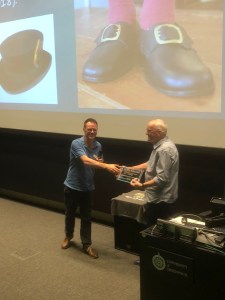
Michael Coffey presents the JPMHN Award to Philip Burnard

This year’s JPMHN Lifetime Achievement Award went to Philip Burnard, Emeritus Professor in the School of Healthcare Sciences at Cardiff University, and I was very pleased to have the opportunity to introduce Phil to those present. Phil’s oeuvre is a remarkable one, comprising books and papers on interpersonal and communication skills, research methods, ethics, culture, stress and burnout, and much more. The Scopus database lists 181 articles which Phil has authored, including one (A method of analysing interview transcripts in qualitative research) which has been cited well over 1,000 times. Phil gave a frank, and drily humorous, account of his early life, his career in nursing practice and academia, and his experiences of depression. I enjoyed hearing Phil speak, too, of his attachments to shoes and hats (as the photo in this post confirms).

Big congratulations indeed to Geoff and Phil, and worth noting that information on nominations for future Skellern Lecturers and JPMHN Achievement Awards can be found here. The day following this year’s event involved a return to the University of Greenwich, hosted by Deborah Watkins, John Crowley and colleagues, for the summer meeting of Mental Health Nurse Academics UK. Our surroundings were, surely, the grandest in which we’ve ever gathered as a group, being within the Maritime Greenwich World Heritage Site. Our meeting was particularly well-attended, with people making the journey from all four countries of the UK. Guest speaker was Dave Munday from Unite the Union, who gave an update on the #MHnursingFuture campaign. Also discussed were the new NMC standards and the assessment of mental health nursing students’ practice, MHNAUK’s recent responses to consultations and position papers, and (via a presentation from Mary Chambers) research impact. We meet again at the University of Essex in the Autumn.

#MHNR2018 scientific committee and more

img_0567-1Today I’ve been at this year’s meeting of the International Mental Health Nursing Research Conference scientific committee. This convened at the Royal College of Nursing headquarters in London. We had a good range of abstract submissions to deliberate over, and people can expect emails soon informing them of our decisions. We’re also pleased to have been able to identify our annual Mental Health Nurse Academics UK Lecturer for 2018. I dare not make an announcement on this front in this post, and shall wait for official communications to be made first.

Hopefully #MHNR2018, which takes place in Manchester in the middle of September, will be a lively and well-attended affair. There is, it has to be said, space for the conference committee to receive and deliberate over a larger number of conference abstracts than it did today. For #MHNR2019, my early request is: spread the word, and get writing. And for #MHNR2018, for people who missed the abstract submission date: do consider, if possible, participating as a delegate anyway.

Elsewhere, having been stuck in the PLOSONE editorial and peer review system for a spectacularly long period, this week’s good news on the mental health research front includes the acceptance for publication of a paper reporting the COCAPP metanarrative review of care planning and coordination. This has been lead authored by Aled Jones, and once it becomes available in the public domain I’ll post a link. Also accepted for publication this week is a paper lead authored by Jane Davies, derived from her PhD which I supported as a supervisor with Danny Kelly. Jane’s study was an investigation into choice and control in young people with cancer, and this article accepted by the European Journal of Oncology Nursingreports some of Jane’s main findings.

Talking of publications, later this week I head into a meeting of the Cardiff University Press editorial board. Up to now I haven’t written much on this site about the Press, which has been around since 2014 and supports journal publishing in diamond open access form. The Press is in the process of extending into monograph publishing, too, having struck an agreement with Ubiquity. For people looking to move their existing journal titles, or to found new ones, the Press is a good place to go and information on opportunities of this type can be found here.

Joining mental health nursing

Mental health nursing is important and fulfilling work, and offers a fine and rewarding career. More people also need to be doing it. By way of background, last month Mental Health Nurse Academics UK (MHNAUK) submitted a response to Health Education England (HEE)’s Facing the Facts, Shaping the Future draft health and care workforce strategy for England to 2027. Contained in this HEE draft are figures on trends in the numbers of nurses, by field of practice, employed in NHS England over the period 2012 to 2017.
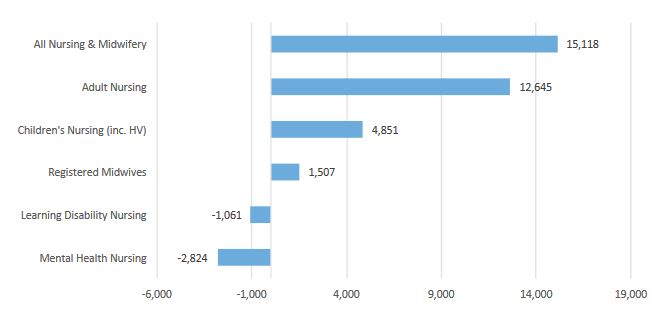
Growth/reduction in NHS employed nurses and midwives by field, 2012 to 2017 (extracted from Facing the Facts, Shaping the Future)

Obvious at a glance from this figure is the decline in both mental health and learning disability nursing numbers over time. Elsewhere HEE also describes a 14% mental health nursing vacancy rate.

Now, the Nursing Times reports a reduction for the second year in a row (£) in the numbers of applications for nursing degrees received via the Universities and Colleges Admissions Service (UCAS). Declining applications need to be viewed in the context of the removal of bursaries for students of nursing enrolling at English universities. In MHNAUK we have said, more than once, that we fear the loss of bursary support poses a particular threat to our field of practice. The same applies to learning disability nursing, where at least one degree programme closed last year (£).

Evidence like this is why initiatives like #MHnursingFuture (see also here, for the Twitter account) are important. Initiated by Dave Munday from Unite the Union, this is all about celebrating the work of mental health nurses and encouraging others to join us. As an occupational group we haven’t always been good at describing what we do, and why what we do is valuable (£). This needs to change, now more than ever.

With all this in mind this may be a good time to remind people of this useful page, hosted on the MHNAUK website, on joining the profession. As this says:

Forget all the stereotypes about straitjackets and Victorian asylums; modern mental health nursing focuses on helping and supporting people from all walks of life with a variety of ‘common’ mental health disorders (such as anxiety and depression) as well as more serious disorders such as drug and alcohol problems, suicidal feelings, psychosis, bipolar disorder and dementia. They also play a key role in promoting mental health and well-being among the public and preventing mental health problems occurring in the first place.

This helpful MHNAUK resource also includes suggestions for further reading, included in which are texts describing in detail many of the skills that mental health nurses routinely use and the context in which they go about their work. And, for any reader contemplating applying to any of the 60+ mental health nursing degree courses offered throughout the UK, do give some thought to our undergraduate nursing programmes here in the School of Healthcare Sciences at Cardiff University.