Category: Nursing

Increasing the visibility of research

Where publishers’ copyright rules permit, since last year I have been uploading green open access versions of peer reviewed research papers I have written or co-written to ORCA, Cardiff University’s digital repository. I have then been adding hyperlinks to these papers to research-related posts on this blog. To round this all off I’ve been using Twitter to draw attention to what I’ve been up to.

Having a WordPress blog means that I get to see which hyperlinks anonymous readers are following, and I know that some onward clicks are taking people to my open access articles. At the end of last week I asked colleagues managing ORCA if any tools existed to help me find out which of my papers have been downloaded, and when.

What I now have is access to an application allowing me to interrogate ORCA in all sorts of ways. So I know, for example, that full-text papers I have authored and saved to the repository have been downloaded 360 times between January 1st 2005 (the earliest date I can select) and today, July 3rd 2013. Two hundred and eighty eight of these downloads have taken place since November 24th 2012, this being the date I created this blog and first posted.

Here is a summary of my ORCA ‘eprints’ and the number of times each has been downloaded up to today:

Eprint Fulltext Downloads
Hannigan, Ben and Allen, Davina Ann 2013. Complex caring trajectories in community mental health: contingencies, divisions of labor and care coordination. Community Mental Health Journal 10.1007/s10597-011-9467-9
file
150
Hannigan, Ben and Coffey, Michael 2011. Where the wicked problems are: the case of mental health. Health Policy 101 (3) , pp. 220-227. 10.1016/j.healthpol.2010.11.002
file
70
Coffey, Michael and Hannigan, Ben 2013. New roles for nurses as approved mental health professionals in England and Wales: A discussion paper. International Journal of Nursing Studies 10.1016/j.ijnurstu.2013.02.014
file
65
Hannigan, Ben and Allen, Davina Ann 2011. Giving a fig about roles: Policy, context and work in community mental health care. Journal of Psychiatric and Mental Health Nursing 18 (1) , pp. 1-8. 10.1111/j.1365-2850.2010.01631.x
file
24
Hannigan, Ben 2013. Connections and consequences in complex systems: insights from a case study of the emergence and local impact of crisis resolution and home treatment services. Social Science & Medicine 10.1016/j.socscimed.2011.12.044
file
20
Hannigan, Ben and Allen, Davina Ann 2006. Complexity and Change in the United Kingdom’s System of Mental Health Care. Social Theory & Health 4 (3) , pp. 244-263. 10.1057/palgrave.sth.8700073
file
18
Hannigan, Ben and Allen, Davina Ann 2003. A tale of two studies: research governance issues arising from two ethnographic investigations into the organisation of health and social care. International Journal of Nursing Studies. 40 (7) , pp. 685-695. 10.1016/S0020-7489(02)00111-6
file
13

All are papers I have specifically blogged about, and have subsequently flagged up on my Enduring posts page. I am therefore going to tentatively conclude that the approach I have taken to increase the visibility of my research is having an effect.

What I do not know is who has been downloading (and hopefully reading!) these articles, and for what purposes. I would like to think it has been a mixture of researchers, practitioners, managers, policymakers and service users. I also hope they have found what they have read to have been both interesting and useful.

Jobs for new nurses

One of the things I’ve been doing recently is meeting up with final year students about to complete their degrees and register with the Nursing and Midwifery Council. These are hard-working, committed, people who have chosen to prepare for careers in mental health nursing. They’re now looking for jobs, and from what I’m hearing opportunities locally and nationally are few and far between.

Here, then, is the sharp end of NHS underfunding. There’s no question that new mental health nurses are required. In fact, we should expect demand to increase at a time of hardship. The problem is that vacancies are being frozen and services are generally retracting. As economic collapse fuels distress and increases need austerity bleeds public services of the capacity to respond.

So, good luck to everyone preparing to qualify. I hope you get the jobs you want and deserve, because you’re needed.

Stress and community mental health nurses

A particular aim of mine in starting this blog was to bring research I have been involved in to a wider audience. So with this in mind, here is a post introducing readers to a series of studies I worked on, with Cardiff colleagues, from the late 1990s to around 2006.
The All Wales Community Mental Health Nursing Stress Study was our first project, led by Professor Philip Burnard. Included in the team were Deborah Edwards, Dave Coyle, Anne Fothergill and myself. Our funding was from the GNC for England and Wales Trust, and we aimed to find out about the causes, moderators and outcomes of stress in community mental health nurses (CMHNs) working in Wales. Our data were generated using a demographic questionnaire and these previously created measures:

  • Maslach Burnout Inventory
  • General Health Questionnaire (GHQ-12)
  • Rosenberg Self-Attitude Questionnaire
  • Community Psychiatric Nursing Stress Questionnaire (Revised)
  • Psychnurse Methods of Coping Questionnaire

Our first published paper was this literature review, which Scopus tells me has thus far been cited in 66 subsequent publications. We went on to publish a series of data-based articles from the study, in some of the journals whose names I have added to the word cloud above. The references for these papers are listed here, along with a brief summary of our headline findings.

The team’s next study was a systematic review of stress management in the mental health professions. This was funded by the Wales Office of R&D for Health and Social Care, which was the predecessor body to NISCHR. We found far more papers describing how stressed people are than we found papers suggesting solutions to this problem. Follow this link for a reference list and project summary.

Finally in this series of projects was a study ‘to identify the factors that may influence the effectiveness of clinical supervision and to establish the degree to which clinical supervision might influence levels of reported burnout in community mental health nurses in Wales, UK‘. An expanded team this time included Linda Cooper, John Adams and Tara Jugessur. This study involved the distribution of two questionnaires, again to community mental health nurses in Wales:

  • Maslach Burnout Inventory (MBI)
  • Manchester Clinical Supervision Scale

This project, too, has a webpage giving details of our main findings and of our published papers.

In the years since this last project concluded I have had conversations with people on what the next line of inquiry might be. The questions we first asked some 15 years ago seem to me to be as relevant today as they were then. I imagine there remain large numbers of very stressed and burned-out mental health practitioners out there. I also suspect there is still work to do to protect the well-being of staff, and to promote their resilience.

Mental Health Nurse Academics UK meets in Liverpool

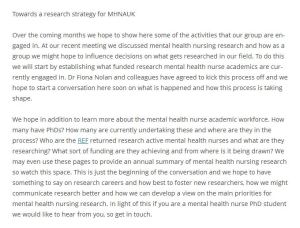
Yesterday Mental Health Nurse Academics UK met at Liverpool John Moores University, for its third and final meeting of this academic year. Hosts were Lisa Woods and Grahame Smith, and the chair was Michael Coffey. In the first part of the day Grahame and Lisa gave an excellent presentation on their cross-European Innovate Dementia project. Business items included updates on plans made at the previous MHNAUK meeting held in March in Cardiff. Andy Mercer presented findings from his and Karen Wright‘s survey of the methods used by universities to select new students of mental health nursing. Fiona Nolan asked members of the group for their suggested items to be included in her forthcoming research expertise, interests and capacity mapping exercise. This will be useful indeed, and at some point soon we will have a better idea of the full range of mental health nursing research being conducted within the UK’s universities.

Teaching preparation and bursaries

The formal academic year for students of the health professions (and therefore for their teachers, too) tends to be on the long side. Whilst many UK university students will have ended their studies until the autumn there are plenty of nurses, midwives and others with work to do before they can knock off for the summer. In September I’ll be working with pre-registration, second year, students of mental health nursing in a module assessed through the critiquing of published research. Before then I have a short, intensive, module to lead which is part of the taught component within the School’s professional doctorate.

This doctoral level module is all about ‘complexity’ and ‘systems’ and starts next month, and today I’ve been putting the finishing touches to some of the materials I’ll be using. As befits the student group and their thesis-producing aspirations I have opted to draw heavily on colleagues’ and my research experiences as far as is possible. I’m also hoping to foster a spirit of studying and learning together, and want to avoid being didactic.

Elsewhere today, in addition to research project-related work, I have had the opportunity to be part of a panel considering applications for RCN Foundation bursaries. There were some strong candidates, and well done to all who are about to get letters confirming their success. Others will be invited to interview (which I personally am unable to take part in). My commiserations, too, to those dropping out at this stage. I know how it feels to apply for support and not to get it, but there are always other opportunities. As I once heard someone, somewhere, say: if you’re not getting funding bids rejected you’re not applying enough!

Theses, vivas and research students

I’ll be examining another doctoral thesis soon, which today I’ve started reading. I won’t say anything about it specifically, but the occasion does give me a starting point for this post.

My own PhD thesis ran to about 450 pages, references and appendices included. It was years in the making, not least as I was a part-time student with plenty of other things to keep me busy. My supervisors, who I’ve mentioned on this blog before, were Davina Allen and Philip Burnard. As an internal candidate it was necessary for me to have two external examiners, and these were Ian Norman from King’s College London and Lesley Griffiths from Swansea University. Here’s the summary from my study:

My viva went well, proceeding in a spirit of collegial inquiry. This is how it ideally should be, and even where a thesis is judged to have major weaknesses I firmly believe that the examination should be conducted fairly and with courtesy. Cardiff University vivas are independently chaired, which I think helps the process, though I know this is not standard practice everywhere.

As it happens the Cardiff School of Nursing and Midwifery Studies has significantly grown its postgraduate research in recent years, and we now have a healthy number of UK and international PhD and Professional Doctorate students. Together they run a lively multi-author blog under the title PhDays. Check it out.

First reflections on two days away

A series of train journeys home gives me space to mull over two days spent in London. Yesterday opened with a meeting of the COCAPP Lived Experience Advisory Group (LEAG), expertly chaired by the wonderful Alison Faulkner. Significantly, key parts of COCAPP are changing in response to LEAG recommendations. Our semi-structured interview schedules, for example, directly reflect the LEAG’s input. This is all good, and I am personally learning huge amounts from the opportunity to be involved.

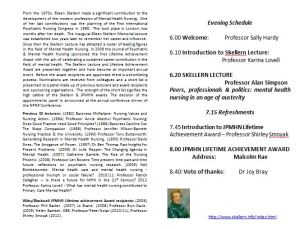
Yesterday evening saw Alan Simpson give his Skellern Lecture followed by Malcolm Rae receiving his Journal of Psychiatric and Mental Health Nursing Lifetime Achievement Award.

As entirely anticipated Alan gave an informed, engaging and challenging talk, which took in his personal journey into mental health nursing and conveyed key messages from his research. Alan gave us plenty to think about. Might peer support workers be attractive to managers with squeezed budgets? Might they begin to replace members of more established groups, nurses included? Or, as Alan hoped, can peer support workers, nurses and others work side-by-side in harmonious fashion for the benefit of people using services?

Malcolm Rea I do not personally know, though based on the talk on leadership in mental health nursing he gave yesterday this has been my loss. I shall remember his contrasting of ‘drains’ and ‘radiators’ (and try personally to be more of the latter than the former).

Yesterday ended with a convivial social in a London pub, and today was more COCAPP: this time a team meeting followed by a Project Advisory Group (PAG) skillfully chaired by John Larsen from Rethink. Some of our discussion centred on the finer aspects of COCAPP’s design and methods, and for that the study will benefit.

So there we are then: only the shortest summary of some pretty involved discussions, but it will do for now. Home calls.

Skellern lecture, JPMHN lifetime achievement award and MHNAUK

Just enough time for me to draw attention to some important happenings about to take place in the world of mental health nursing. Tomorrow evening (June 12th) Alan Simpson delivers this year’s Skellern Lecture and Malcolm Rae receives his Journal of Psychiatric and Mental Health Nursing Lifetime Achievement Award. Here are the flyers for these linked events, both taking place at City University London:

Next week brings this term’s meeting of Mental Health Nurse Academics UK, taking place at Liverpool John Moores University. Hosts are Lisa Woods and Grahame Smith, and the agenda is looking interesting.