Now that I have learned how to embed YouTube videos into this blog (it isn’t difficult, really) I can update this morning’s post by adding a clip of Welsh Government Minister for Health and Social Services Professor Mark Drakeford speaking, on the occasion of World Mental Health Day 2013, at the Senedd. My thanks to Hafal for using its twitter account to draw my (and everyone else’s) attention to this:
Category: Mental health
World Mental Health Day 2013
Today is World Mental Health Day. Here’s a snip from the WHO:
Every year on 10th of October, The World Health Organization joins in celebrating the World Mental Health Day. The day is celebrated at the initiative of the World Federation of Mental Health and WHO supports this initiative through raising awareness on mental health issues using its strong relationships with the Ministries of health and civil society organizations across the globe. WHO also develops technical and communication material and provides technical assistance to the countries for advocacy campaigns around the World Mental Health Day.
The theme of World Mental Health Day in 2013 is “Mental health and older adults”.
Here in Wales, the day is being marked by (amongst other things) the organisation Hafal bringing its latest campaign, Lights! Camera! ACTION!, to the Senedd in Cardiff. From Hafal’s website I see that this event will be attended by the Welsh Government Minister for Health and Social Services, Professor Mark Drakeford. I hope this all goes well, as I’m sure it will. Last month’s revelation that Asda, Tesco and Amazon were selling ‘mental patient fancy dress costumes’ reminds us (as if it were needed) of the progress still to be made to improve public understanding of mental health issues and to tackle stigma and discrimination.
For a general overview of mental health priorities and challenges around the world, here’s a five minute video produced by the World Health Organization:
Teesside story
So here’s a brief post from a train, as I make my way home from Mental Health Nurse Academics UK‘s meeting at Teesside University. The journey is long, but the company is good: next to me is Michael Coffey, and in front are Linda Cooper and Julia Terry.
The day has been an interesting one. Len Bowers reprised findings from his Safewards trial (and very important they are, too). Ian Hulatt and Joy Duxbury led a discussion on positive behavioural support. PBS? Not something I know much about, I have to confess. The possibility of establishing research priorities for mental health nursing was also explored. I now realise, as I type, that a discussion on Twitter is taking place on what these priorities might be. A similar round is taking place on themes for future MHNAUK meetings. Time to dive in, perhaps?
MHNAUK meeting at Teesside University
 This afternoon I’m off to Darlington (a place I’ve never visited before) ahead of tomorrow’s Mental Health Nurse Academics UK (MHNAUK) meeting. As a reminder, MHNAUK’s website can be found here, and its blog can be found here.
This is going to be a considerable train journey (check out the map below), so I’ll be bringing work to be getting on with and plenty of light refreshments. The other thing I’ll be doing en route is catching up with friends and colleagues, where in the course of a normal working week it can be difficult to find time to converse.
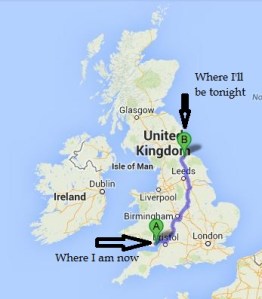
The meeting itself is being hosted by Gordon Mitchell from Teesside University, and is being chaired by Michael Coffey. Taken from the MHNAUK website here is the agenda:
9.15 – 10.00 Arrival and Refreshments
10.00 – 10.10 Welcome from the Chair and Introductions – Michael Coffey
10.10 – 10.20 Welcome to the School and Teesside University – Dean Prof Paul Keane OBE
10.20 – 10.50 Safewards and coercion – Professor Len Bowers
10.50 – 11.20 Department of Health commissioned report on physical interventions – Ian Hulatt, RCN Mental Health Nurse Advisor and Professor Joy Duxbury
11.20 – Discussion re MHNAUK statement on research and education in physical interventions
11.30-11.45 Comfort Break
Main Business
11.45-12.45 Research Priority Setting: a proposal – Professor Len Bowers
Lunch and Networking
13.15 – 13.45 Revisiting Cardiff Proposals – Michael Coffey
13.45 – 14.00 Mental Health Nurse recruitment and selection – Enkanah Soobadoo
14.00 -14.15 NPNR News – Michael Coffey
14.15 – 14.25 Feedback on Academy of Nursing, Midwifery and Health Visiting Research – Professor Alan Simpson
14.25 – 14.35 Mental Health Nurse Metrics – Sue McAndrew
14.35 – 14.45 MHNAUK statement on Dementia care, education and research – Grahame Smith
14.45 – 14.50 Doctoral student network: fringe event at NPNR – Julia Terry
14.50 AOB – Mental Health Nursing history archive – Michael Coffey and MHNAUK new journal discussions – Ben Hannigan
15.00 Close of Meeting
Seminar feast
My, what a treat awaits today: no less than two seminars and discussions in one afternoon. First up (and speaking as part of the School of Health Care Sciences’ 2013-14 seminar series) is Mary Dixon-Woods, who will be talking on ‘Soft intelligence and hard data: how can we know if care is safe?’. In a later South Wales Mental Health Nursing Journal Club and Seminar group meeting, Gerwyn Jones will be speaking on ‘Mental health pre-registration nurses’ satisfaction with problem based learning’.
Seminars, ay? Like proverbial London buses these have a tendency to arrive in multiples. I’ll be dashing from room to room with scarcely time to pause for breath. Best make sure I put the right questions to the right speakers, lest Gerwyn finds himself facing a query about quality and safety and Mary finds herself fielding something on lecturer facilitation of PBL groups.
Nursing stress (2)
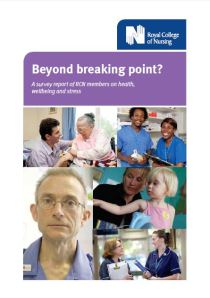 Further to my last post on nurses and stress: an email to the RCN has produced this link to the full Beyond breaking point report.
For those interested, here’s what the conclusion from the Executive Summary says:
The 2012 survey findings highlight the high levels of stress among the nursing workforce. Stress can be a causal factor for health problems, physical injuries, psychological effects and burnout. In addition to the high personal toll, stress is a major cause of both sickness absence and presenteeism and affects the ability of workers to be effective.
The survey reveals that the main causes of stress are high workloads, long hours, unrealistic expectations, lack of job control, conflicting roles, bullying and violence, poor working relationships and a lack of engagement in workplace change. Addressing these problems is an obvious way to improve nurses’ working experience, and in turn improve the safety and quality of care for patients.Issues of workload, stress and working life are, however, often symptomatic of systemic organisational problems. Poor work environments and working relationships damage the ability of nursing staff to provide safe care and there is a direct correlation between job satisfaction and patient satisfaction.
Nursing stress
Today The Guardian reports on a Royal College of Nursing survey into levels of stress amongst 2,000 NHS and private sector nurses. Some of the nurses participating give dire accounts of their working lives when it comes to sickness and time off due to ill-health. Here is a snip from today’s paper:
The RCN said many of the nurses questioned reported that sickness absence policies at their place of work were so punitive that they had no alternative but to attend work despite feeling unwell.
One of the nurses told the RCN: “I’ve been told that if I don’t meet the 100% attendance at work I will be up for a capability hearing. I had three admissions into hospital due to a cardiac problem, so if I get chest pain I have to ignore it because I have to go to work.”
Another said: “I am currently off work following breast cancer. A senior manager called three weeks after my surgery and asked if I was coming back as people with cancer often don’t return and they wanted to fill my post.”
As someone who has investigated stress and burnout in nurses in the past I am interested to know more of this survey (or ‘poll’, as it is described). I can’t find anything in the Guardian‘s news report on the type of study which has been conducted, and I’m turning up a blank when I navigate to the RCN website for a full report. Perhaps I’m missing something?
A day at an exhibition
As an aside, this week I had the chance to visit the British Museum’s Life and death in Pompeii and Herculaneum. A there-and-back trip from South Wales to London in one day is never to be taken lightly, but on this occasion the time and effort was well-spent.
As is well-known, these two cities were catastrophically engulfed in the year 79 by a volcanic eruption of Mount Vesuvius. Excavations from the middle of the 18th century have revealed much about the day-to-day conditions of the people who lived (and died) there. Hundreds of objects from both sites have been brought to London for this exhibition, and the whole is both beautifully presented and utterly fascinating. I say ‘is’ in the knowledge that this coming Sunday is the exhibition’s last day.
What psychological traumas the survivors of this disaster will have suffered. And what, I now find myself idly wondering, was the state of mental health of the Ancient Romans more generally? I have no idea, but a brief search online turns up a book by an academic who definitely does. Seeing this I am reminded that there are so many interesting things to know, and yet so little time to learn them.
Back in the world of work it’s been a week of grant proposals, marking, meetings with students and postgraduate research student progress reviewing. All good, and the term now feels well and truly under way.
Divergence and difference in mental health policy
Yesterday’s main business was a there-and-back trip to the University of Nottingham to act as a PhD external examiner. Reading this (very interesting) thesis in advance, discussing with the candidate at viva and talking with supervisory and examiner colleagues over lunch has reminded me (again) how mental health policy and services in Wales and England are diverging.
As an example, there really is no equivalent to the Mental Health (Wales) Measure on the English side of the Severn Bridge. For those not in the know here, ‘measure’ in this context means ‘law’. The Welsh Government’s brief public summary of this piece of legislation says:
The Mental Health (Wales) Measure 2010 is a new law made by the Welsh Government which will help people with mental health problems in four different ways.
Local Primary Mental Health Support Services
The Measure will make sure that more services are available for your GP to refer you to if you have mental health problems such as anxiety or depression. These services, which may include for example counselling, stress and anxiety management, will either be at your GP practice or nearby so it will be easier to get to them.
You will also be told about other services which might help you, such as those provided by groups such as local voluntary groups or advice about money or housing.
Care Coordination and Care and Treatment Planning
Some people have mental health problems which require more specialised care and support, (sometimes provided in hospital). If you are receiving these services then your care and treatment will be overseen by a professional such as a psychiatrist, psychologist, nurse or social worker. These people will be called Care Coordinators and will write you a care and treatment plan – working with you as much as possible. This plan will set out the goals you are working towards and the services that will be provided by the NHS and the local authority and other agencies to help you reach them. This plan must be reviewed with you at least once a year.
Assessment of people who have used specialist mental health services before
If you have received specialised treatment in the past and were discharged because your condition improved, but now you feel that your mental health is becoming worse, then you can go straight back to the mental health service which was looking after you before and ask them to check whether you need any further help or treatment. You don’t need to go to your GP first, although you may wish to talk it through. You can ask for this up to three years after you are discharged from the specialist team.
Independent Mental Health Advocacy
If you are in hospital and you have mental health problems you can ask for help from an Independent Mental Health Advocate (IMHA). An IMHA is an expert in mental health who will help you to make your views known and take decisions in relation to your care and treatment (but will not take decisions on your behalf!)
COCAPP, as some readers of this blog will already know, is investigating care planning and care coordination in community mental health: so the Care Coordination and Care and Treatment Planning component of the Measure is a really important part of the study’s context. It will be interesting to see how far national-level legal and policy differences are ‘felt’ at the level of everyday practice.
There are other important differences in emphasis across the two countries, too. I hear anecdotally that to save money some of the work done by England’s assertive outreach and early intervention teams is being called back into comprehensive, locality-based, community mental health teams (CMHTs). Assertive outreach and early intervention teams, alongside crisis resolution and home treatment services, sprung up in England in the first decade of this century following the publication of the National Service Framework for Mental Health, the Policy Implementation Guide and the NHS Plan. Here the strategy document Adult Mental Health Services for Wales, which appeared in 2001, was strong in its commitment to CMHTs and as a result (I have always thought) we never had quite the range of differentiated services which England had. We have, of course, got crisis services in Wales, as I have previously written about here, here and here.
And it’s not only in the mental health field that policy and services are diverging. We have no clinical commissioning groups in Wales, for the obvious reason that the Health and Social Care Act 2012 applies to England only (for more on this, check out this post dating back to the time I heard Raymond Tallis speak at the Hay Festival).
Evidence syntheses and the RiSC study
I’ve been working on a document associated with the RiSC study today. RiSC is an evidence synthesis of ‘risk’ for young people moving into, through and out of inpatient mental health services. To guide our review we’re using a framework developed by members of the the EPPI-Centre, about which more can be found by clicking on the logo below:
Distinct about the EPPI-Centre approach is the emphasis placed on engaging with representatives of groups and communities with interests in the area under review. In their Methods for Conducting Systematic Reviews document the EPPI-Centre people write:
Approaches to reviewing
Involving representatives of all those who might have a vested interest in a particular systematic review helps to ensure that it is a relevant and useful piece of research.
User involvement
Everyone has a vested interest in public policy issues such as health, education, work and welfare. Consequently everyone, whether they wish to be actively engaged or not, has a vested interest in what research is undertaken in these fields and how research findings are shared and put to use.
Reviews are driven by the questions that they are seeking to answer. Different users may have different views about why a particular topic is important and interpret the issues within different ideological and theoretical perspectives.
Involving a range of users in a review is important as it enables reviewers to recognise and consider different users’ implicit viewpoints and thus to make a considered decision about the question that the review is attempting to answer. The aim is to be transparent about why a review has the focus that it does, rather than assuming it is, or is attempting to be, everything to everyone.
In our review (as you’ll see if you download our protocol from the link given at the top of this post above) we’re combining a broad descriptive mapping of the territory with a more selective, in-depth, review guided by the priorities of stakeholder representatives. These are people with experience of using, working in or managing child and adolescent mental health services.
I like this approach to conducting evidence reviews, appreciating the commitment it demands to the agreement of topic areas and to being open in decision-making. All going well I’ll be continuing with some RiSC work tomorrow.
 Ben Hannigan's blog