Category: Education

Care work and health system complexity

Two interesting collections of papers have caught my eye in the last week or so. Davina Allen has edited an online volume of articles, all previously published in the journal Sociology of Health & Illness, addressing the sociology of care work. In her editorial Davina sets the scene with reference to the Francis Inquiries and concludes with this:

[…] in the wake of Francis the predominant response to raising the quality of care and compassion has been to focus on the attributes of individuals and wider regulatory arrangements. As we have seen, however, the kind of care that can be provided depends fundamentally on the social organisation of care work, which in turn hinges on what we (society) are prepared to pay for. Francis has called for national fundamental care standards, but this requires more careful attention to the models of care-giving practice that will sustain them, including care-giver roles, the inter-relationship of care work components and features of the organisational context. The papers in this collection reveal there are no easy answers to these questions, but the insights they yield make an important contribution to these debates. In bringing the papers together in this virtual special issue the aim is to both raise the profile of the individual contributions, but also their collective value to this critical issue of public and policy concern.

Meanwhile, Tim Tenbensel, Stephen Birch and Sarah Curtis have edited a special issue of Social Science & Medicine devoted to the study of complexity in health and health care systems. I have a personal interest here, as it is in this collection of new papers that my article Connections and consequences in complex systems: insights from a case study of the emergence and local impact of crisis resolution and home treatment services appears. Describing himself as ‘a sympathetic outsider to complexity theory’, Tim Tenbensel in his editorial closes with this:

[…] perhaps the most important conceptual issue for complexity theory seems to be the place of ‘top-down’ interventions in complex systems. Are they part of the landscape of complexity, or are they things that ‘impede’ the unfolding of self-organising, emergent phenomena? More sophisticated applications of complexity suggest the former answer, yet the will to control through linear, rational, prescriptive mechanisms remains an ever-present shadow – something that should be minimised – because it this a defining trope of complexity theory applied to the social sciences. This theoretical challenge is perhaps most pressing in contexts in which health services are directly funded from public sources.

My apologies to the doctoral students whose ‘complex systems’ module I taught a few weeks ago, who may erroneously have thought that I knew what I was talking about, but like Tim Tenbensel I regard myself as being a relative newcomer to this whole complexity approach. So I for one am looking forward to reading the other papers in this new collection, and to learning plenty that is new.
Writing an undergraduate dissertation

Here’s a link to a full-text green open access version of a paper called Preparing and writing an undergraduate dissertation. Philip Burnard and I published this in Nurse Education in Practice in 2001. Our aim was to produce something of practical use to students working on what is, typically, their single biggest piece of written work.

I appreciate that my timing here is very poor. Right now most students will be on, or planning for, their summer holidays. So I’ll draw attention to this paper again once the new academic year has started.

The accidental grounded theorists

On Friday I had reason to ponder the relationships between theory and data, and the boundaries between different types of qualitative research. This was day two of my Working and Leading in Complex Systems professional doctorate module. What I discovered is that I may, in fact, have become an accidental grounded theorist. Or possibly not…I’ll let the reader decide.

During a talk about critical junctures I said how, in our recent paper, Nicola Evans and I had elected to lay out our theoretical contribution (i.e., our idea of ‘critical junctures’ as pivotal, punctuating, moments initiating or taking place within longer individual trajectories of care) ahead of displaying our data. We had done this even though our ‘theory’ had in fact been fieldwork-driven, as we then demonstrated in our article with extended, illustrative, extracts. Quite reasonably, in the classroom I was asked if we had therefore used a grounded theory approach.

This question got me thinking. My immediate response was that Nicola and I had developed a concept from empirical data but had absolutely not claimed to be ‘doing grounded theory’. In fact, the thought had never occurred to us (or to me, at any rate).

And there’s the nub of it. What does it actually mean to ‘do grounded theory’? Follow a stepwise recipe from a methodological cookbook? Or range freely over one or more sets of data in the search for new insights? Without wanting to suggest that ‘anything goes’ in terms of methods, I wonder if we can sometimes get too hung up on techniques and ‘rules’ when it’s the principles which really matter? In our critical junctures paper these included a commitment to the inductive ‘drawing out’ of conceptual insights from an analysis of talk and action. They also included the idea of staying close to our data, and of offering fieldwork extracts in support of the theory. I personally have no wish to agonise over what flavour of ‘doing qualitative research’ we have done here, and I’m also not sure that all of the finer distinctions and sub-divisions necessarily matter or even make sense.

But perhaps I’m missing something.

Learning about complexity and systems

Today has reminded me of the pleasures of university teaching. A day in a classroom with lively doctoral students is to be savoured. Most (but not all) of the group were nurses, and most (but again, not all) were completing the taught elements of their professional doctorate programme ahead of beginning their research.

The module is concerned with understanding health system complexity, and is liberally sprinkled with local research (my own included). Today we began with an overview of the territory, and then discussed policy and services at the large scale using the idea of wicked problems. Pauline Tang gave a fabulous talk based on her study of electronic health records, before we closed with a whistlestop tour of systems of work and divisions of labour.

We meet again tomorrow for sessions led by students, to think about trajectories and critical junctures, and to hear Nicola Evans being interviewed about change in organisations. I’m looking forward.

Vivas, research projects and the Welsh Government on the Francis Report

There’s plenty going on in the continuing baking sun this week. I was pleased to spend yesterday at Sheffield University (where I was once a student) examining, and recommending awarding, a doctorate addressing the use of problem based learning in mental health nursing education.
Meanwhile COCAPP is now generating data, and the RiSC project has reached a critical point as a search strategy is devised for its second phase. And tomorrow and on Friday I’ll be in the classroom with a group of professional doctorate students, talking and learning about systems and complexity.

Elsewhere, via the twitter account of the Minister for Health and Social Services, Mark Drakeford I’ve spotted the Welsh Government’s response to the Report of the Mid Staffordshire NHS Foundation Trust Public Inquiry. I see there will be an annual Quality Statement for the NHS in Wales from next year, and a future NHS Wales Quality Bill.

Summer sun

Just as predicted by those nice people at the Met Office, South Wales is warming up. The sun is high, and I hear the voices of schoolchildren playing football. I’ve been stuck inside all day, which in the circumstances has been something of a drag, but in the last hour or so I’ve gravitated outside to soak up some of this long-awaited summer.

This has been a working week as varied as any. I had a couple of School committees to chair (research ethics, and scientific review), some teaching (MSc), and a meeting with colleagues to plan some pre-registration interprofessional education in the autumn. This is a continuing mental health nursing/occupational therapy initiative (which I’ve posted about before), and on this occasion we’re planning some technological innovation involving the use of video recording and playback. On the research front I’ve been working on RiSC and keeping in touch with COCAPP, and found myself contributing to a rapidly convened meet-up to talk through a brand new project idea. I received page proofs for our new Critical junctures paper, peer reviewed a manuscript submitted for publication, and received a citation alert from Scopus. This was particularly pleasing as it took my ‘h’ index to 15, for what that’s worth. I also completed preparations for a doctoral examination taking place next Tuesday, and managed to squeeze in a pleasant catch-up with an esteemed colleague working in NHS mental health services. Mostly we exchanged news of developments in practice, services and research locally.

And with that, I’m off. Beer in the back garden calls.

Jobs for new nurses

One of the things I’ve been doing recently is meeting up with final year students about to complete their degrees and register with the Nursing and Midwifery Council. These are hard-working, committed, people who have chosen to prepare for careers in mental health nursing. They’re now looking for jobs, and from what I’m hearing opportunities locally and nationally are few and far between.

Here, then, is the sharp end of NHS underfunding. There’s no question that new mental health nurses are required. In fact, we should expect demand to increase at a time of hardship. The problem is that vacancies are being frozen and services are generally retracting. As economic collapse fuels distress and increases need austerity bleeds public services of the capacity to respond.

So, good luck to everyone preparing to qualify. I hope you get the jobs you want and deserve, because you’re needed.

Mental Health Nurse Academics UK meets in Liverpool

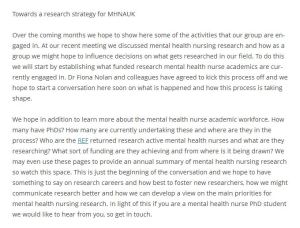
Yesterday Mental Health Nurse Academics UK met at Liverpool John Moores University, for its third and final meeting of this academic year. Hosts were Lisa Woods and Grahame Smith, and the chair was Michael Coffey. In the first part of the day Grahame and Lisa gave an excellent presentation on their cross-European Innovate Dementia project. Business items included updates on plans made at the previous MHNAUK meeting held in March in Cardiff. Andy Mercer presented findings from his and Karen Wright‘s survey of the methods used by universities to select new students of mental health nursing. Fiona Nolan asked members of the group for their suggested items to be included in her forthcoming research expertise, interests and capacity mapping exercise. This will be useful indeed, and at some point soon we will have a better idea of the full range of mental health nursing research being conducted within the UK’s universities.