Category: Education

MHNAUK meeting at Teesside University

This afternoon I’m off to Darlington (a place I’ve never visited before) ahead of tomorrow’s Mental Health Nurse Academics UK (MHNAUK) meeting. As a reminder, MHNAUK’s website can be found here, and its blog can be found here.

This is going to be a considerable train journey (check out the map below), so I’ll be bringing work to be getting on with and plenty of light refreshments. The other thing I’ll be doing en route is catching up with friends and colleagues, where in the course of a normal working week it can be difficult to find time to converse.
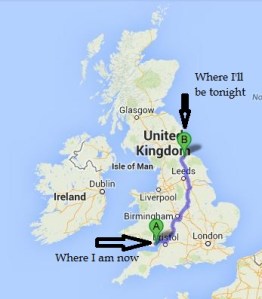
The meeting itself is being hosted by Gordon Mitchell from Teesside University, and is being chaired by Michael Coffey. Taken from the MHNAUK website here is the agenda:

9.15 – 10.00 Arrival and Refreshments

10.00 – 10.10 Welcome from the Chair and Introductions – Michael Coffey

10.10 – 10.20 Welcome to the School and Teesside University – Dean Prof Paul Keane OBE

10.20 – 10.50 Safewards and coercion – Professor Len Bowers

10.50 – 11.20 Department of Health commissioned report on physical interventions – Ian Hulatt, RCN Mental Health Nurse Advisor and Professor Joy Duxbury

11.20 – Discussion re MHNAUK statement on research and education in physical interventions

11.30-11.45 Comfort Break

Main Business

11.45-12.45 Research Priority Setting: a proposal – Professor Len Bowers

Lunch and Networking

13.15 – 13.45 Revisiting Cardiff Proposals – Michael Coffey

13.45 – 14.00 Mental Health Nurse recruitment and selection – Enkanah Soobadoo

14.00 -14.15 NPNR News – Michael Coffey

14.15 – 14.25 Feedback on Academy of Nursing, Midwifery and Health Visiting Research – Professor Alan Simpson

14.25 – 14.35 Mental Health Nurse Metrics – Sue McAndrew

14.35 – 14.45 MHNAUK statement on Dementia care, education and research – Grahame Smith

14.45 – 14.50 Doctoral student network: fringe event at NPNR – Julia Terry

14.50 AOB – Mental Health Nursing history archive – Michael Coffey and MHNAUK new journal discussions – Ben Hannigan

15.00 Close of Meeting

Seminar feast

My, what a treat awaits today: no less than two seminars and discussions in one afternoon. First up (and speaking as part of the School of Health Care Sciences’ 2013-14 seminar series) is Mary Dixon-Woods, who will be talking  on ‘Soft intelligence and hard data: how can we know if care is safe?’. In a later South Wales Mental Health Nursing Journal Club and Seminar group meeting, Gerwyn Jones will be speaking on ‘Mental health pre-registration nurses’ satisfaction with problem based learning’.

Seminars, ay? Like proverbial London buses these have a tendency to arrive in multiples. I’ll be dashing from room to room with scarcely time to pause for breath. Best make sure I put the right questions to the right speakers, lest Gerwyn finds himself facing a query about quality and safety and Mary finds herself fielding something on lecturer facilitation of PBL groups.

A day at an exhibition

As an aside, this week I had the chance to visit the British Museum’s Life and death in Pompeii and Herculaneum. A there-and-back trip from South Wales to London in one day is never to be taken lightly, but on this occasion the time and effort was well-spent.

As is well-known, these two cities were catastrophically engulfed in the year 79 by a volcanic eruption of Mount Vesuvius. Excavations from the middle of the 18th century have revealed much about the day-to-day conditions of the people who lived (and died) there. Hundreds of objects from both sites have been brought to London for this exhibition, and the whole is both beautifully presented and utterly fascinating. I say ‘is’ in the knowledge that this coming Sunday is the exhibition’s last day.

What psychological traumas the survivors of this disaster will have suffered. And what, I now find myself idly wondering, was the state of mental health of the Ancient Romans more generally? I have no idea, but a brief search online turns up a book by an academic who definitely does. Seeing this I am reminded that there are so many interesting things to know, and yet so little time to learn them.

Back in the world of work it’s been a week of grant proposals, marking, meetings with students and postgraduate research student progress reviewing. All good, and the term now feels well and truly under way.

Evidence syntheses and the RiSC study

I’ve been working on a document associated with the RiSC study today. RiSC is an evidence synthesis of ‘risk’ for young people moving into, through and out of inpatient mental health services. To guide our review we’re using a framework developed by members of the the EPPI-Centre, about which more can be found by clicking on the logo below:EPPI Centre

Distinct about the EPPI-Centre approach is the emphasis placed on engaging with representatives of groups and communities with interests in the area under review. In their Methods for Conducting Systematic Reviews document the EPPI-Centre people write:

Approaches to reviewing
Involving representatives of all those who might have a vested interest in a particular systematic review helps to ensure that it is a relevant and useful piece of research.
User involvement
Everyone has a vested interest in public policy issues such as health, education, work and welfare. Consequently everyone, whether they wish to be actively engaged or not, has a vested interest in what research is undertaken in these fields and how research findings are shared and put to use.
Reviews are driven by the questions that they are seeking to answer. Different users may have different views about why a particular topic is important and interpret the issues within different ideological and theoretical perspectives.
Involving a range of users in a review is important as it enables reviewers to recognise and consider different users’ implicit viewpoints and thus to make a considered decision about the question that the review is attempting to answer. The aim is to be transparent about why a review has the focus that it does, rather than assuming it is, or is attempting to be, everything to everyone.

In our review (as you’ll see if you download our protocol from the link given at the top of this post above) we’re combining a broad descriptive mapping of the territory with a more selective, in-depth, review guided by the priorities of stakeholder representatives. These are people with experience of using, working in or managing child and adolescent mental health services.

I like this approach to conducting evidence reviews, appreciating the commitment it demands to the agreement of topic areas and to being open in decision-making. All going well I’ll be continuing with some RiSC work tomorrow.

NPNR 2013 conference review

Health and health services are political. I therefore applaud those who selected the ‘personal and the political’ as the theme for this year’s Network for Psychiatric Nursing Research conference.

A word on the keynotes:

Kate Pickett‘s Thursday morning opener pressed home how disastrous inequalities are, for all of us. For those not there to hear Kate speak there’s plenty of compelling evidence available via The Equality Trust website, and indeed in The Spirit Level (which I now realise I must read).

Simon Duffy, in his keynote yesterday, challenged mental health nurses to act collectively and assertively to improve welfare. I believe he was correct in pointing out that public services are often experienced as fragmented, bureaucratic and impersonal. Check out the Centre for Welfare Reform website for more in this area.

Charles Walker, Conservative MP for Broxbourne, has spoken openly about his personal experiences of obsessive compulsive disorder and until recently was Chair of the All Party Parliamentary Group for Mental Health. His Thursday afternoon conversation with the NPNR audience was stylishly done, and whilst I can’t bring myself to vote for his party (not now, not ever) I do appreciate what he has done to challenge discrimination.

Len Bowers used his Thursday keynote to share, for the first time anywhere, results from his Safewards trial. Len is a genuinely world leading researcher, and Safewards is a big and important study with seriously major implications for policy, services, education and practice. Take note, inpatient mental health nurses: the findings from this one are coming your way.

Rounding off the whole event yesterday afternoon was Fiona Nolan, sharing results from her pilot study of the use of protected engagement time (PET) by inpatient mental health nurses. Fiona’s was another great presentation, and her and her colleagues’ findings are important because (despite the push from policymakers) they suggest PET offers no additional benefits to service users.

Other items of news: warm congratulations to Joy Duxbury, who will be delivering the Eileen Skellern Lecture for 2014, and to Hugh McKenna, who will be receiving the Journal of Psychiatric and Mental Health Nursing Lifetime Achievement Award. Two fine people, and worthy winners both.

The concurrent sessions I had the chance to participate in were of uniformly high-quality, and there was plenty of discussion and debate to be had. I’d also like to think that this year’s event maintained the NPNR’s reputation for combining quality with informality and collegiality. For the record, my view is that nothing of great consequence was lost in moving the conference, for the first time ever, away from Oxford. Warwick worked well, and as others have said via their post-event tweets, it’s the people not the place which matter.

See you next year.

Reflections on a pre-conference week

Funding for Welsh students and Welsh universities is in tonight’s news, I see, and I’m beginning to wonder how long the Welsh Government’s current policy in this area will survive. More immediately, it’s been a varied enough week for me personally: and that’s without my two days at the NPNR conference in Warwick which begin with a frighteningly early start tomorrow morning. But at least I’ll have Gerwyn Jones and Mohammad Marie in the car for company, so all will be well.

Highlights so far include a meeting of (most of) the excellent RiSC team (which includes the newly-professored Steven Pryjmachuk), to make further progress on our evidence review of ‘risk’ for young people moving into, through and out of inpatient mental health services. This is a two-phase project, and we’re now in the second segment. This is involving searches for research and other materials across a number of databases, and putting out calls for evidence to local services and other organisations.

Data has continued to be generated in COCAPP, and this week a date has been set for a first planning meeting for an exciting new project I am involved in led by Michael Coffey. More to follow on this in the fullness of time, I expect. And yesterday took me to a second meeting of the Mental Health Research Network Cymru Service User and Carer Partnership Research Development Group, an event convened at Hafal‘s premises located in the grounds of the magnificent St Fagans: National History Museum. A good place, St Fagans: well worth a visit.

Elsewhere there have been comments to make on students’ draft assignments, research ethics committee work, undergraduate teaching to prepare (on roles in health and social care teams) and writing plans to be laid. I’ve also been reading a PhD ahead of a viva scheduled in the next few weeks. So this short post will do for tonight: time to knock off, iron some shirts, pack a bag and have an early night.

Improving physical health

A common refrain amongst mental health nurses is that our knowledge, skills and contributions are poorly understood and undervalued by our physical healthcare nurse colleagues. As a nurse trained in both mental and physical health care fields I have sympathy with this position. But I also wonder if our concern with meeting mental health need has caused us to lose sight of the importance of physical health? I am again reminded of Professor Graham Thornicroft’s recent editorial in the BMJ on the scandal of early death in people with mental illness. Mental health nurses have a real part to play in promoting physical wellbeing and facilitating access to services, in their capacity as direct providers and as coordinators of care. Locally, I see evidence that some are taking this part of their work seriously. I know of mental health nurses who, as part-time MSc students, are motivated to develop smoking cessation programmes in hospitals and to introduce wellbeing screening clinics in the community.

With all this in mind it was interesting to see the most recent issue of the International Journal of Mental Health Nursing carrying a series of papers on this topic. There are contributions on: the work of mental health nurses in primary care; promoting access; attitudes, knowledge and training needs; and the physical activity levels of people with mental ill-health. Worth a read, I think.

Unrelatedly, here in England and Wales we are midway through an extended (bank holiday) weekend. This is all pretty meaningless to those nurses for whom shiftwork goes on as usual. Occupying the privileged position that I do, this afternoon brings not a trip to the office but, instead, the first visit of the new season to the Cardiff City Stadium. There, the newly promoted Bluebirds play their inaugural home game in football’s Premier League. Against Manchester City, it’s going to be tough. But whatever the outcome I know we’ll enjoy the occasion.

New school

A quick post. Today I returned to work from a fortnight away in the knowledge that, at the start of next month, the Cardiff School of Nursing and Midwifery Studies will be joining with the School of Healthcare Studies to become the new School of Health Care Sciences (but not the Cardiff School of Health Care Sciences, unless I’ve missed something?). This change will bring academic nurses, midwives, occupational therapists, physiotherapists, radiographers, operating department practitioners and medical photographers (and all our students) together in a single department. I hope I’ve not missed anyone out in this list: apologies if so.

I’m sure there will be some headaches and hiccups along the way as people and processes adjust, but I understand the idea behind this move and broadly welcome it. Hopefully both research and education will benefit, and it will be good to work more directly with people who have similar interests (in the mental health field, for example) but who happen not to be nurses.

Anyway, more immediately today was the small matter of picking up some important research threads. This included preparing for tomorrow’s service user researcher meeting, in which we’ll be discussing (and using) interview schedules in preparation for fieldwork. I also had the chance to correct proofs for a new article, which I’ll blog about in time. But now it’s late, so I’m off.

All change in East London

How pleasing it was to discover, during a return trip this week to East London, that the site of the now-disused St Clement’s Hospital (this being where I trained as a mental health nurse) is becoming the UK’s first community land trust. This means that the space will be developed for permanently affordable housing for local people.

Having cast an eye through the windows of London estate agents during this trip away I can see why there’s a need. The capital has become a prohibitively expensive place to live and work, it seems.

As it happened, our visit on August 8th coincided with the opening of the Shuffle festival. Curated by Danny Boyle (who made an appearance) this is bringing film, music and other good stuff to the St Clement’s site ahead of its redevelopment.

Further west, in Whitechapel, we discovered that the Royal London Hospital has been built anew under a private finance initiative scheme. The front parts of the old hospital remain, but are unused and propped up from behind for purely ornamental purposes.

At the back, the original nurses’ homes and other notable venues (including the Oxford Arms pub) have been entirely demolished to make way for a tall, exceptionally shiny, new main building. For the time being the Princess Alexandra Building, this being the old School of Nursing site in Philpot Street, remains.

All in all It is – we had to conclude – looking very different.

Thoughts on the occasion of having written 100 posts

My first post was written and uploaded to this site on November 24th last year. I wrote about my interest in exploring the mental health system’s ‘wicked problems’, and drew attention to an article Michael Coffey and I had recently published in this area. In this, my 100th post, I want to think a little about what I have learned using a blog as a medium of communication.

As a mental health nurse academic my job involves researching and writing. I have wanted this site to be a vehicle for bringing some of this work to a wider audience. The main way I have gone about doing this has been to write posts to surround published articles, and where copyright makes this possible to add links to full-text green open access versions of papers stored on Cardiff University’s ORCA digital repository. The link above to Michael’s and my paper on wicked problems is an example. I’d like to think that this strategy has had some effect. As I wrote in this post last month, copies of papers I have deposited and then blogged about have been downloaded. By whom I cannot know. Nor can I be sure what use, if any, people have made of what they’ve read. If anyone wants to let me know, then that would be all to the good.

Over the last eight to nine months I have also learned that a blog needs looking after. So in addition to writing about research I have taken the opportunity to write generally about other things I do at work or am interested in, or about stuff which has simply caught my eye. My approach has been to write little, but to write often. I reflect that adding small pieces here and there has helped me in my teaching, as I noted earlier here. I also realise that in blogging beyond research I have blurred my boundaries somewhat, having added notes along the way about (for example) the simple pleasures of running. As an aside, I’ve been plagued by minor, but annoying, running-related injuries over the last few months and am missing my forest jaunts very much.

Just as a peer reviewed, published, article can be given a leg-up by a post on a blog, so too can a new blog be supported by a tweet. I have taken to using Twitter to draw attention to newly published posts, and indeed have started using this (sporadically, it has to be said) as another, independent, way of exchanging ideas.

That’ll do, for now. But I conclude that I’ll maintain this site in its small niche for a while longer yet.