Category: Education

Educating nurses

The Nursing and Midwifery Council is consulting on its programme of change for education. Information can be found here, and there’s a lot of it. Mental Health Nurse Academics UK (MHNAUK) will be submitting a response, with Anne Felton from Nottingham University (who leads MHNAUK’s Education Standing Group) coordinating this work.

On July 11th, with mental health nurse academic colleagues in the School of Healthcare Sciences in Cardiff I spent part of our annual summer away day formulating a team response to the NMC’s proposals. Once we’re happy with the content we’ll be forwarding it to Anne, and simultaneously submitting directly to the NMC.

Individually and collectively, other mental health nurses will be formulating responses too. For now, the NMC confirms that the four nursing fields (mental health, adult, child and learning disability) will remain. For an explanation of the importance of preserving mental health nursing as a pre-registration speciality, follow this link for MHNAUK’s relevant position paper. But, as MHNAUK Chair Steven Pryjmachuk pointed out last month in this piece (ÂŁ) for the Nursing Times, the list of nursing procedures contained in the NMC’s draft standards of proficiency is heavily skewed towards the adult field. This is the Cardiff University mental health team’s concern too, and we’ll be saying so (with specific examples) in our response. Another place for this (and any other) view to be given is at this forthcoming WeMHNurses chat:

Meanwhile, last week ended with two days of professional doctorate teaching. With Nicola Evans I lead a module which addresses working in, and examining, complex systems of health and social care. We’ve run this module before, and as always the student group was a lively and engaged one. Amongst the things we discussed together are the connections running within and between systems of different scale, and the sometimes unforeseen consequences of introducing change. These are matters about which both Nic and I have written (see here, here, here and here). 

To link the two parts of this post together: the NMC is a big player, and for better or worse its programme of education reform will trigger significant disruption. A systems thinking perspective encourages us to consider the possible impact of the NMC’s proposals alongside other sources of change. These include the introduction of fees for student nurses in England, the arrival of nursing associates and reductions in the size of the UK’s registered nurse workforce. As cumulative shifts take place I’m hoping mental health nursing as a distinct profession emerges intact, with its current and future practitioners able to fulfil their places in a system which continues to very much need them. 

Skellern Award and MHNAUK meet-up

My general election postal vote cast, June 8th began with a PhD examination at City University London moving as the day progressed to London South Bank University for this year’s Eileen Skellern Lecture and Journal of Psychiatric and Mental Health Nursing Lifetime Achievement Award.

As Skellern Lecturer Mary Chambers gave a fine, interactive, presentation emphasising the importance of making visible the invisible work of mental health nurses. Here’s Mary with Ben Thomas and Isaac Marks, no less. Amongst other things Mary talked about her work developing the Therapeutic Engagement Questionnaire, a tool designed to establish the value of mental health nursing.

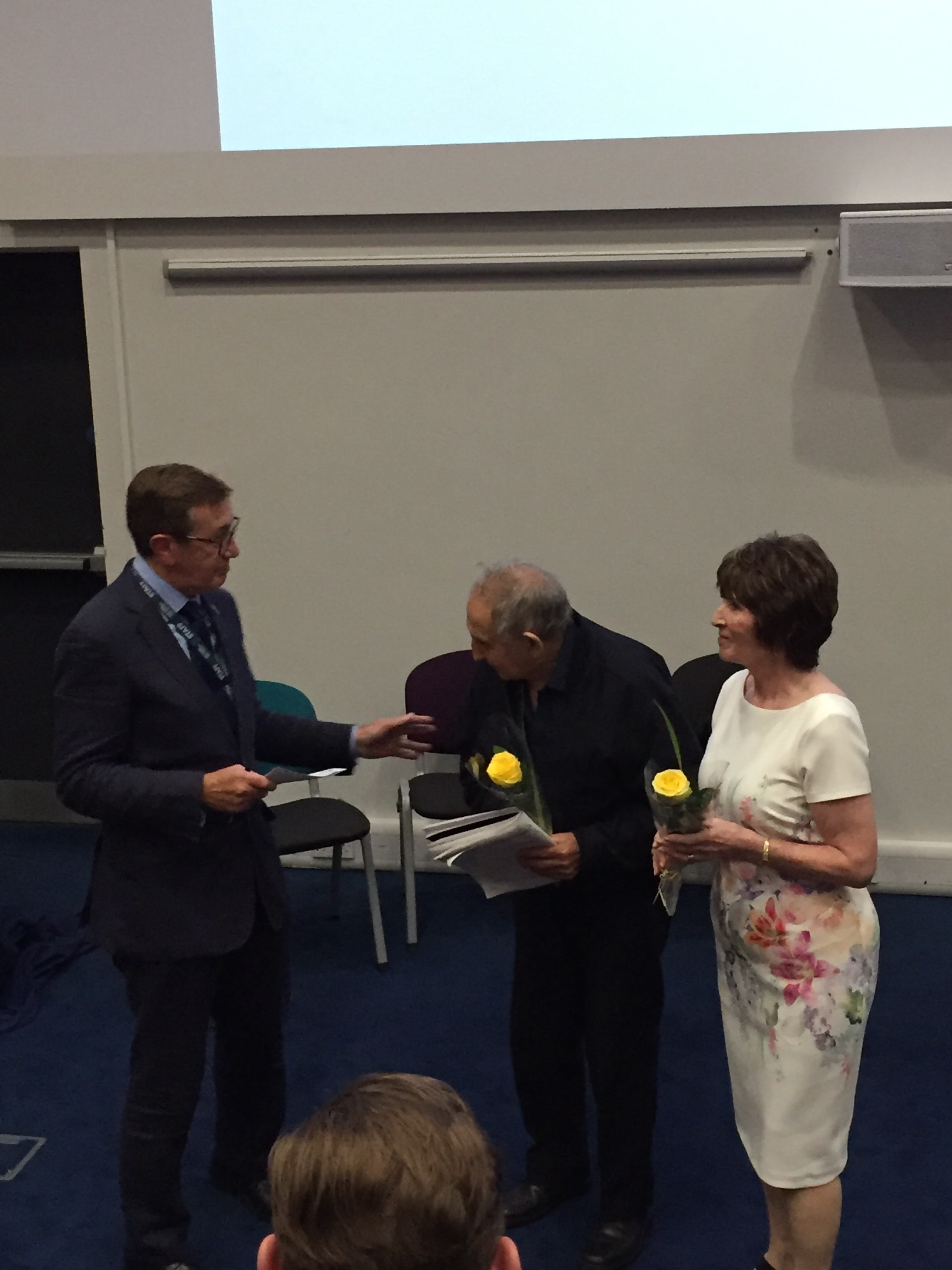
Len Bowers was recipient of the Lifetime Achievement Award. He gave a deeply personal, altogether humorous, account of his career in mental health nursing, highlighting in particular the curious accidents which helped propel him to the forefront of the profession. Len’s Safewards programme, of course, was no accident and his contribution to improving mental health nursing practice through research of this type continues to be sorely missed in the months following his retirement. Here he is receiving his award from Alan Simpson.

Friday was a meeting of Mental Health Nurse Academics UK, hosted by Sally Hardy at London South Bank University. Detailed notes from the meeting will appear in due course on the group’s website. In the morning Katie Evans from the Money and Mental Health Policy Institute talked about the associations between mental health problems and money difficulties, making the point that debt advice (which is a regulated activity) needs to be incorporated into care pathways where necessary.

MHNAUK is in the process of setting up permanent standing groups, covering the areas of: research; education; policy and practice; and communication. Each group now has a lead person, and each group has plenty to do. The education group, led by Anne Felton, will be coordinating MHNAUK’s response to the NMC’s consultation on proposed new standards for pre-registration nurses. At this last week’s meeting, under the education group agenda item, members heard about plans for this autumn’s #FutureMHN conference. The research group, led by Mary Chambers, will be coordinating MHNAUK’s work in the context of the future Research Excellence Framework. On Friday, as part of the research group update I gave a progress review for this year’s #MHNR2017 conference. The policy and practice group is led by John Baker, and members (John included) have been working on (amongst other things) safe staffing. The final group is communications, led by Steven Pryjmachuk and me.

#MHNAUK Lecturer wanted

The clock is winding down on the call for abstracts for the 23rd International Mental Health Nursing Research conference, taking place in Cardiff on September 14th-15th. As readers of the relaunched website of Mental Health Nurse Academics UK will know, nominations are currently being sought for the inaugural MHNAUK Lecturer. Reflecting the work of MHNAUK the Lecture will:

[…] be delivered by a mental health nurse in, or out of, the UK who in the opinion of the MHNR committee, the Chair and the Vice Chair of MHNAUK has made a significant contribution to the promotion and enhancement of mental health nursing education, research, policy and/or practice.

Perhaps, over the coming bank holiday weekend, readers of this blog might give some thought about possible nominees? We’re welcoming self-nominations, and nominations coming from others.

As always, spread the word!


#MHNAUK meets at the University of Hertfordshire

MHNAUK met on March 31st at the University of Hertfordshire, hosted by Greg Rooney and chaired by Steven Pryjmachuk. Anne Trotter from the NMC was welcomed for a detailed discussion on the development of new standards for pre-registration nursing, and on the NMC’s wider work to create a framework for education of which this is […]

via #MHNAUK meets at the University of Hertfordshire  — MHNAUK

Out with the old

Happy new year. In one of my earliest posts on this blog I wrote of coming across a fallen tree. Over the months and years following this became something of a local landmark for those of us fond of making the trip over Craig yr Allt by foot. The tree was removed sometime last autumn, with tyre tracks telling a tale. I’ll add its disappearance to the long list of last year’s losses, included on which are Carrie Fisher, George Michael and the security of Britain remaining in the EU.

2016-10-28-08-40-23

If 2016 had more than its fair share of trampling, and like the track up Craig yr Allt bowed out with its topsoil removed, perhaps this year will be different. Or maybe not. Anyway…

As 2017 gets underway I’ve opened my term of office as Vice Chair of Mental Health Nurse Academics UK with a fruitful conversation with Steven Pryjmachuk, the group’s Chair for this year and next. Ideas for refreshing the MHNAUK website, and our March meeting at the University of Hertfordshire, were amongst things on the agenda. We’ll have lots to talk about; as I observed in my last post, a number of important things are afoot with likely changes to the education of nurses and the beginnings of plans being laid for the next research excellence framework.

Elsewhere, the forthcoming care planning and care coordination themed issue of the Journal of Psychiatric and Mental Health Nursing which Michael Coffey, Alan Simpson and I are guest editing is taking shape nicely. We have some super articles lined up, and will be writing editorials in the near future.

Later in the year, in September, the newly renamed International Mental Health Nursing Research Conference (the NPNR, as was) meets in Cardiff. I’ll be off to a conference planning meeting in London in a week’s time where we’ll be talking about a theme for #MHNR2017 and possible keynote speakers. I’ll perhaps blog something about that when we’re done.

marie-et-al-2017On the publications front, Mohammad Marie has lead authored (with Aled Jones and me in support) this latest paper. It’s all about the challenges faced by Palestinian community mental health nurses, and represents the fourth article emerging from Mohammad’s PhD thesis in something like 18 months. That’s good going indeed. Here’s the abstract:

Background:
Nurses in Palestine (occupied Palestinian territory) work in a significantly challenging environment. The mental health care system is underdeveloped and under-resourced. For example, the total number of nurses who work in community mental health centres in the West Bank is seventeen, clearly insufficient in a total population of approximately three million. This research explored daily challenges that Palestinian community mental health nurses (CMHNs) face within and outside their demanding workplaces.
Methods:
An interpretive qualitative design was chosen. Face-to-face interviews were completed with fifteen participants. Thirty-two hours of observations of the day-to-day working environment and workplace routines were conducted in two communities’ mental health centres. Written documents relating to practical job-related policies were also collected from various workplaces. Thematic analysis was used across all data sources resulting in four main themes, which describe the challenges faced by CMHNs.
Results and conclusion:
These themes consist of the context of unrest, stigma, lack of resources, and organisational or mental health system challenges. The study concludes with a better understanding of challenges in nursing which draws on wider cultural contexts and resilience. The outcomes from this study can be used to decrease the challenges for health professionals and enhance the mental health care system in Palestine.


In with the new

Following a discussion involving the event’s steering committee and Mental Health Nurse Academics UK (MHNAUK), what was the International Network for Psychiatric Nursing Research Conference has now become the International Mental Health Nursing Research Conference. Next year we meet in Cardiff on September 14th and 15th, and early information can be found here. This site will be updated as further plans are made, so it’s worth checking in from time to time. We’ve also updated our conference twitter feed; clicking takes you there. Our hashtag, which is already in use, is #MHNR2017.

For a taster of the conference, here are links to four of last year’s keynote presentations: Steven Pryjmachuk, Elaine Hanzak, Luciana Berger MP and Bryn Lloyd-Evans:

Meanwhile, I’m pleased to have been elected as Vice Chair of MHNAUK. I’ll be working with the Chair, Steven Pryjmachuk, throughout 2017 and 2018 before becoming Chair at the start of 2019 for a further two years. I’m grateful for the opportunity colleagues have given me, and will do my best to lead and represent the group and the wider field. I anticipate having plenty to do, noting changes ahead in the education of nurses, the funding of students and the run-in to the next research excellence framework. More on all these to follow, I’m sure: with time today to draw attention to the decision by the Welsh Government to continue bursary payments in 2017-18 for eligible students of nursing, midwifery and the allied health professionals. As the press release announcing this makes clear, individuals taking this offer up will need to commit ‘in advance to taking up the opportunity to work in Wales, post qualification, for a period of two years’. Entirely unclear are funding arrangements for the period from 2018-19 onwards.

Playing our Part

A short post this morning to draw attention to Professor Tony Butterworth’s Playing our Part review, this being something which occupied me towards the start of last week. With the support of the Foundation of Nursing Studies Tony is conducting a review of mental health nursing, by mental health nurses. I made the trip to the (very plush) King’s Fund headquarters in London’s Cavendish Square on Monday, where FoNs is currently in residence, to join an educators’ group discussing responses to a series of questions Tony had set for us in advance. The questions were of a type always easier to ask than to answer (‘how do you prepare students to uniquely become mental health nurses?’, and ‘do you think that students should be exposed to some form of basic psychosocial education skills at undergraduate level?’ being two examples). We talked lots about the interpersonal aspects of nursing, and the enduring importance of relational work, but also about the roles that mental health nurses fulfil in managing the system and coordinating care. I’ll be keeping an eye on the Playing our Part blog over the coming weeks as Tony continues his tour through the UK, meeting groups of nurses to draw out their views and experiences. The final report, as I understand it, is due to appear towards the end of the year. 

Elsewhere I’ve been working with co-conspirators to fine-tune next week’s #AfterWhitchurch ESRC Festival of Social Science event at Chapter in Cardiff. I’ll have to post something uniquely about that once we’re done. 

Collaborative care for depression

Happy April. Here’s a new venture for me: blogging for the Mental Elf, part of the National Elf Service. This is a fine site indeed, which AndrĂ© Tomlin set up in 2011 with the aim of helping people find ‘just what you need to keep up-to-date with all of the important and reliable mental health research and guidance’.

Here’s a summary of my first post, which can be read in full by following the link at the bottom.

Ben Hannigan writes his debut blog on the CADET cluster RCT, which investigates the clinical effectiveness and cost-effectiveness of collaborative care for depression in UK primary care.

via Collaborative care for depression: acceptable, effective and affordable — Elf Service – National Elf Service

#MHNAUK meets in Leeds, and talks work and roles

MHNAUK members in Leeds
MHNAUK meets in Leeds

Mental Health Nurse Academics UK met yesterday in Leeds, hosted by John Baker and chaired by Joy Duxbury. Our discussions were wide-ranging: proposed changes to the composition of the English NHS workforce signalled by the introduction of associate nurses; the arrival, in England, of student fees for nursing degrees from 2017; safe staffing (see also this editorial in the Journal of Psychiatric and Mental Health Nursing); plans for #NPNR2016; arrangements for a second student mental health nursing conference; the Shape of Caring; England’s Five Year Forward View for Mental Health; guidance for adult field nurses caring for people with mental health problems; this year’s Skellern Lecture and JPMHN Lifetime Achievement Award; the current call for papers for a themed care planning and coordination issue of the Journal of Psychiatric and Mental Health Nursing (which Michael Coffey, Alan Simpson and I are co-editing); and the hot-off-the-press announcement of a Foundation of Nursing Studies-sponsored review into the role of mental health nurses.

In this post I’ll largely confine myself to some thoughts on the mental health workforce and on the place of nurses within this. Yesterday’s discussions in this area exercised MHNAUK members greatly. Proposed changes to the occupational mix to be found within mental health services, debates over nursing numbers and safe staffing, and new arrangments for the funding of education have the potential to trigger significant turbulence in an already-complex system of care. MHNAUK members rightly identified how the appearance of a new associate nurse role, sitting in between health care support workers and registered nurses, will trigger unrest. This is always the case when professional jurisdictions come under pressure (see here and here for papers I have co-written which expand on this point). In this current case, some registered nurses will see new associates as a threat to their hard-won jurisdiction. At a time when nurses are pressing for safe staffing, some are likely to argue that the introduction of associates will also open the door to role substitution and eventual reductions in numbers of registered nurses, thereby threatening both quality and safety.

Should associate nurses appear, we can be certain that plenty of inter-occupational jostling will take place as support workers, associates and registered nurses (amongst others) negotiate their relative positions and assert control over areas of work. In this regard, abstract descriptions of the tasks which new associates will (and will not) be permitted to carry out will provide only the most limited of guides. Differentiations between who does what will inevitably be hammered out in the workplace.

And what of the cross-UK implications for all of this, given that the Department of Health’s associate nurse announcement is for England only? To me it is unclear how new associates will be regulated, or how transferable their future qualifications might be should any wish to move to, say, Wales. Across the four countries of the UK important differences are appearing in the ways people are prepared for health care practice, and in the funding of this. Student nurses will pay fees in England from next year, but student nurses in Scotland will not and will continue to receive a bursary. Here in Wales (unless I’ve been asleep and have missed a piece of essential news), we will need to wait until after our forthcoming Assembly elections and the formation of a new Welsh Government for an announcement on future financial arrangments for nursing education. Perhaps we’ll hear more about the shape of the future Welsh NHS workforce then, too.