Time this morning to quickly upload this:
mental health, nursing, policy, services, people, research, education
Month: January 2016
In a post on this site last year I drew attention to the (highly contested) decision by NICE to suspend its work on safe nurse staffing in inpatient mental health settings. Now, and with thanks to Shaun Lintern from the Health Service Journal (and to John Baker, who amongst mental health nurses has worked particularly hard to keep this issue alive), NICE’s evidence review in this area has just been published.
Here’s how the news was broken earlier this week:
Here’s a quick summary. Seven research questions were asked in the review, with searches made of fifteen databases for evidence published since 1998. To be included, studies had to report on at least one of:
Studies were eligible for inclusion if they reported findings from inpatient mental health areas serving people of any age. Outcomes of interest included serious incidents (e.g., self-harm, violence), delivery of nursing care (e.g., levels of contact) and other (e.g., nurse vacancy rates). Following a process of searching and sifting just 29 papers were finally included, and subject to quality appraisal. And the conclusions? Here they are, as extracted by John Baker with a call for action:
Follow @benhannigan
Not for the first time, I’ve attempted to produce some cumulative insights from the past and present mental health research studies I’ve had the opportunity to work on. These include my PhD investigation into work and roles in community mental health care, my post-doctoral study of crisis services, and more recent projects which Alan Simpson, Michael Coffey or I have led on.
The prompt, on this occasion, has been the chance to give a presentation at a School of Healthcare Sciences research seminar taking place this afternoon. For anyone interested, here is the PowerPoint I used. I opened with some general comments on the need for mental health research, and on the funding landscape. I then had some things to say about theory, design and methods. Many of the individual slides have hyperlinks to green open access publications:
Follow @benhannigan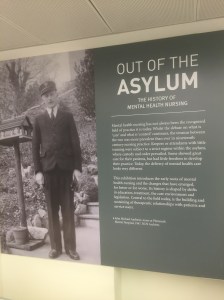 Belated happy new year. Visiting the Royal College of Nursing headquarters in London last Friday ahead of a meeting of the Network for Psychiatric Nursing Research (NPNR) conference committee (more on that below) gave me an opportunity to pop into the ‘Out of the Asylum’ exhibition. I’m glad I did. Texts, photographs and other artefacts illustrate the history of mental health nursing.
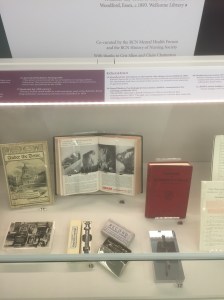 Here are some of the pictures I took. These include a photo of the RCN’s copy of a sixth edition of the Red Handbook, displayed alongside nurses’ badges, a Bethlem Royal Hospital pamphlet, a syringe and other items of interest. For more on the Red Handbook see this earlier post, along with this post which includes material from my copy of a fourth edition of the same. Another picture relates a set of regulations for the bathing of patients.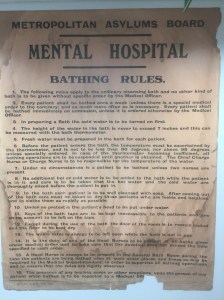
One of the display boards makes the observation that ‘few mental health nurses now wear uniforms’. As an unfortunate aside, this may need some future updating. From what I’m hearing, the historic trend towards mental health nurses wearing everyday clothes at work is reversing, with numbers of NHS trusts and health boards contemplating a return to uniforms. I regret that. But sticking with the exhibition…

…a final photograph I’m reproducing here is the front sheet of an early 1930s examination paper. Look hard and you’ll see questions on bones, asphyxia and antiseptics (amongst other things).
 The NPNR planning meeting, this being the purpose of my trip, was a productive one. This year’s event (the 22nd) will be taking place in Nottingham on September 15th and 16th. I’ll add more on this when I can, and include some regular updates on this site.
 Ben Hannigan's blog