Month: August 2013

Improving physical health

A common refrain amongst mental health nurses is that our knowledge, skills and contributions are poorly understood and undervalued by our physical healthcare nurse colleagues. As a nurse trained in both mental and physical health care fields I have sympathy with this position. But I also wonder if our concern with meeting mental health need has caused us to lose sight of the importance of physical health? I am again reminded of Professor Graham Thornicroft’s recent editorial in the BMJ on the scandal of early death in people with mental illness. Mental health nurses have a real part to play in promoting physical wellbeing and facilitating access to services, in their capacity as direct providers and as coordinators of care. Locally, I see evidence that some are taking this part of their work seriously. I know of mental health nurses who, as part-time MSc students, are motivated to develop smoking cessation programmes in hospitals and to introduce wellbeing screening clinics in the community.

With all this in mind it was interesting to see the most recent issue of the International Journal of Mental Health Nursing carrying a series of papers on this topic. There are contributions on: the work of mental health nurses in primary care; promoting access; attitudes, knowledge and training needs; and the physical activity levels of people with mental ill-health. Worth a read, I think.

Unrelatedly, here in England and Wales we are midway through an extended (bank holiday) weekend. This is all pretty meaningless to those nurses for whom shiftwork goes on as usual. Occupying the privileged position that I do, this afternoon brings not a trip to the office but, instead, the first visit of the new season to the Cardiff City Stadium. There, the newly promoted Bluebirds play their inaugural home game in football’s Premier League. Against Manchester City, it’s going to be tough. But whatever the outcome I know we’ll enjoy the occasion.
Crossing disciplinary boundaries and sharing unrelated datasets

For anyone interested, follow this link for a post I’ve written which has just appeared on the LSE Impact of Social Sciences blog. It’s a reflection on working with Nicola Evans to produce our ‘critical junctures’ paper, which I’ve previously written about here and here.

Doing crisis work

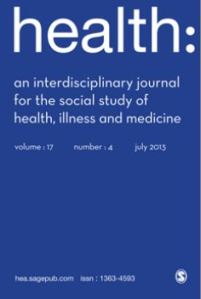
Here’s a new paper just accepted for publication, and about to appear in early online publication form. Titled ‘There’s a lot of tasks that can be done by any’: findings from an ethnographic study into work and organisation in UK community crisis resolution and home treatment services this will be appearing in Health: an Interdisciplinary Journal for the Social Study of Health, Illness and Medicine. Health is published by SAGE, and the copyright agreement I have signed allows me to deposit a post-peer review version of the accepted manuscript in my employing university’s digital repository. So, for a green open access version of this paper which is almost identical to the version which will appear in the journal, follow this link.
For a quick summary, here’s the abstract:

Across the United Kingdom (UK) large numbers of crisis resolution and home treatment (CRHT) services have been established with the aim of providing intensive, short-term, care to people who would otherwise be admitted to mental health hospital. Despite their widespread appearance little is known about how CRHT services are organised or how crisis work is done. This article arises from a larger ethnographic study (in which 34 interviews were conducted with practitioners, managers and service users) designed to generate data in these and related areas. Underpinned by systems thinking and sociological theories of the division of labour, the article examines the workplace contributions of mental health professionals and support staff. In a fast-moving environment the work which was done, how and by whom reflected wider professional jurisdictions and a recognisable patterning by organisational forces. System characteristics including variable shift-by-shift team composition and requirements to undertake assessments of new referrals whilst simultaneously providing home treatment shaped the work of some, but not all, professionals. Implications of these findings for larger systems of work are considered.

I’ll be adding this post, with its embedded link to the open access version of this article, to my ‘enduring posts’ page. I’ll group it with other posts and publications addressing the theme of ‘work and roles’.

New school

A quick post. Today I returned to work from a fortnight away in the knowledge that, at the start of next month, the Cardiff School of Nursing and Midwifery Studies will be joining with the School of Healthcare Studies to become the new School of Health Care Sciences (but not the Cardiff School of Health Care Sciences, unless I’ve missed something?). This change will bring academic nurses, midwives, occupational therapists, physiotherapists, radiographers, operating department practitioners and medical photographers (and all our students) together in a single department. I hope I’ve not missed anyone out in this list: apologies if so.

I’m sure there will be some headaches and hiccups along the way as people and processes adjust, but I understand the idea behind this move and broadly welcome it. Hopefully both research and education will benefit, and it will be good to work more directly with people who have similar interests (in the mental health field, for example) but who happen not to be nurses.

Anyway, more immediately today was the small matter of picking up some important research threads. This included preparing for tomorrow’s service user researcher meeting, in which we’ll be discussing (and using) interview schedules in preparation for fieldwork. I also had the chance to correct proofs for a new article, which I’ll blog about in time. But now it’s late, so I’m off.

All change in East London

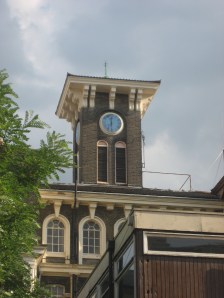
How pleasing it was to discover, during a return trip this week to East London, that the site of the now-disused St Clement’s Hospital (this being where I trained as a mental health nurse) is becoming the UK’s first community land trust. This means that the space will be developed for permanently affordable housing for local people.

Having cast an eye through the windows of London estate agents during this trip away I can see why there’s a need. The capital has become a prohibitively expensive place to live and work, it seems.

As it happened, our visit on August 8th coincided with the opening of the Shuffle festival. Curated by Danny Boyle (who made an appearance) this is bringing film, music and other good stuff to the St Clement’s site ahead of its redevelopment.

Further west, in Whitechapel, we discovered that the Royal London Hospital has been built anew under a private finance initiative scheme. The front parts of the old hospital remain, but are unused and propped up from behind for purely ornamental purposes.

At the back, the original nurses’ homes and other notable venues (including the Oxford Arms pub) have been entirely demolished to make way for a tall, exceptionally shiny, new main building. For the time being the Princess Alexandra Building, this being the old School of Nursing site in Philpot Street, remains.

All in all It is – we had to conclude – looking very different.

Thoughts on the occasion of having written 100 posts

My first post was written and uploaded to this site on November 24th last year. I wrote about my interest in exploring the mental health system’s ‘wicked problems’, and drew attention to an article Michael Coffey and I had recently published in this area. In this, my 100th post, I want to think a little about what I have learned using a blog as a medium of communication.

As a mental health nurse academic my job involves researching and writing. I have wanted this site to be a vehicle for bringing some of this work to a wider audience. The main way I have gone about doing this has been to write posts to surround published articles, and where copyright makes this possible to add links to full-text green open access versions of papers stored on Cardiff University’s ORCA digital repository. The link above to Michael’s and my paper on wicked problems is an example. I’d like to think that this strategy has had some effect. As I wrote in this post last month, copies of papers I have deposited and then blogged about have been downloaded. By whom I cannot know. Nor can I be sure what use, if any, people have made of what they’ve read. If anyone wants to let me know, then that would be all to the good.

Over the last eight to nine months I have also learned that a blog needs looking after. So in addition to writing about research I have taken the opportunity to write generally about other things I do at work or am interested in, or about stuff which has simply caught my eye. My approach has been to write little, but to write often. I reflect that adding small pieces here and there has helped me in my teaching, as I noted earlier here. I also realise that in blogging beyond research I have blurred my boundaries somewhat, having added notes along the way about (for example) the simple pleasures of running. As an aside, I’ve been plagued by minor, but annoying, running-related injuries over the last few months and am missing my forest jaunts very much.

Just as a peer reviewed, published, article can be given a leg-up by a post on a blog, so too can a new blog be supported by a tweet. I have taken to using Twitter to draw attention to newly published posts, and indeed have started using this (sporadically, it has to be said) as another, independent, way of exchanging ideas.

That’ll do, for now. But I conclude that I’ll maintain this site in its small niche for a while longer yet.

COCAPP gets a blog

Time only this morning for a super-speedy post to draw readers’ attention to COCAPP’s new blog. COCAPP is funded by the NIHR Health Services and Delivery Research Programme, and is a cross-national study of care planning and care coordination in community mental health. I’ve written about COCAPP on my blog before, but now recommend interested people get over to the project’s dedicated site to meet the team and to find out the detail of what it’s all about.